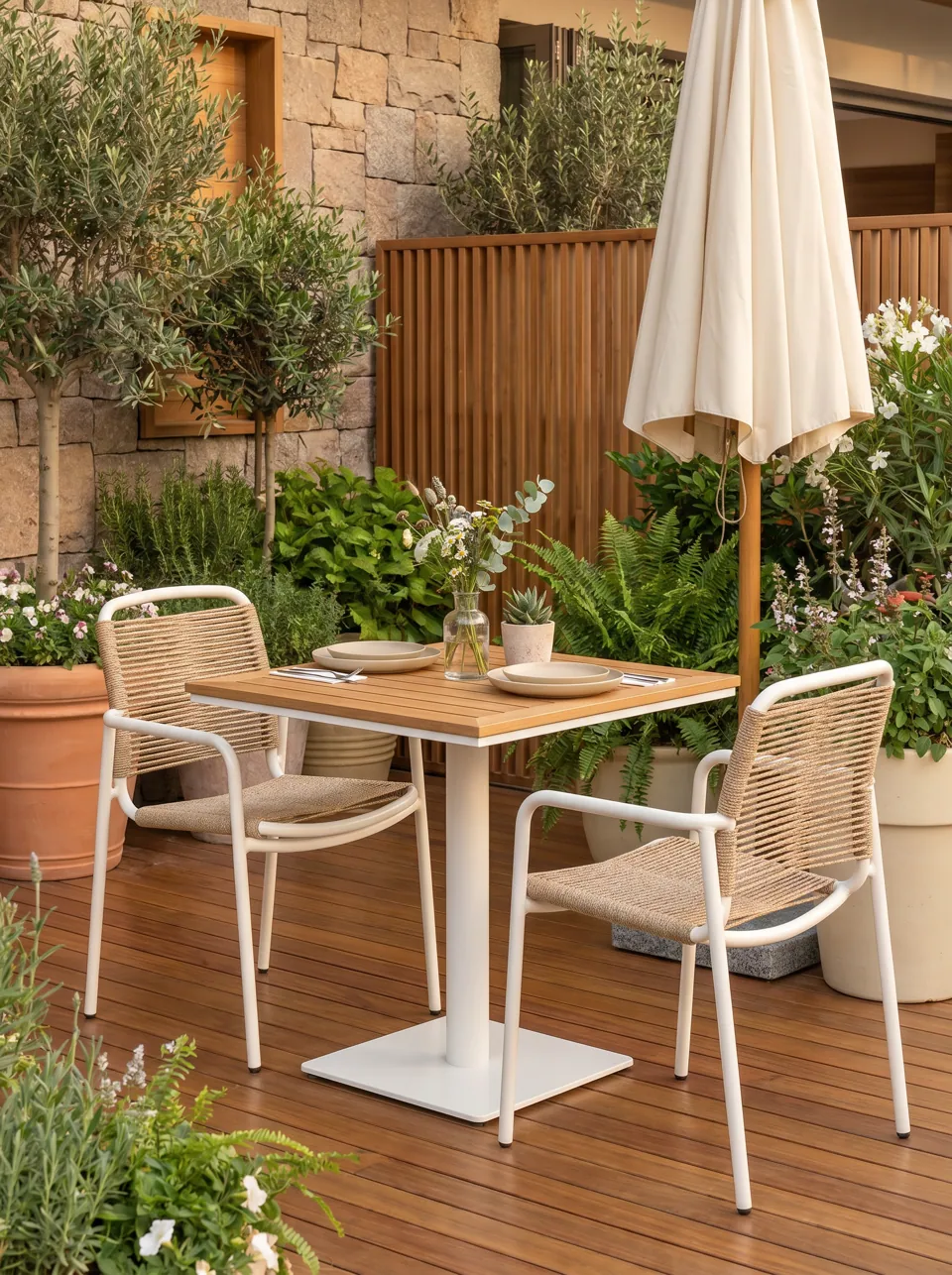
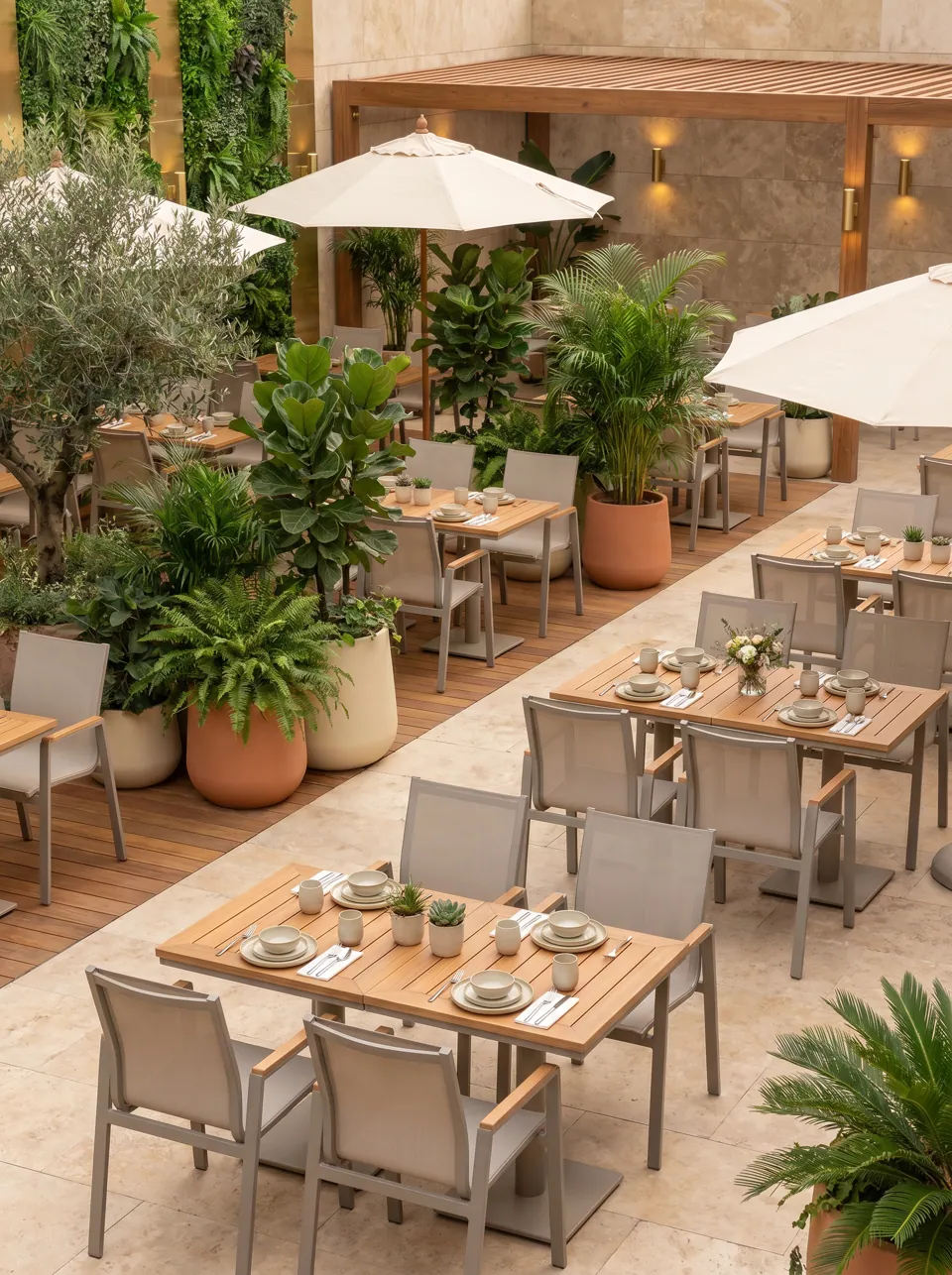
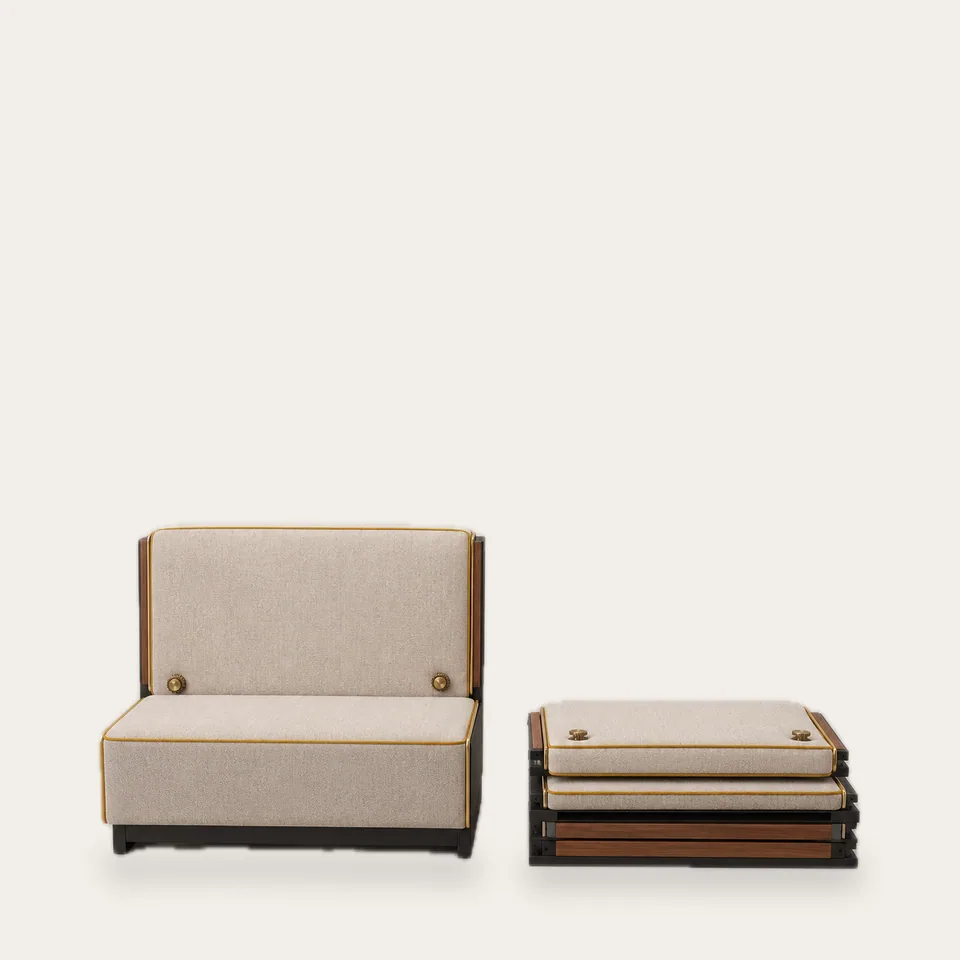
Commercial Outdoor Furniture Materials Compared: Aluminum, Teak, Wicker, Rope and HPL (2026)
Which outdoor furniture material lasts on a restaurant patio? Aluminum, steel, teak, acacia, synthetic wicker, rope and table tops compared for UV, salt air and rust.
Short answer
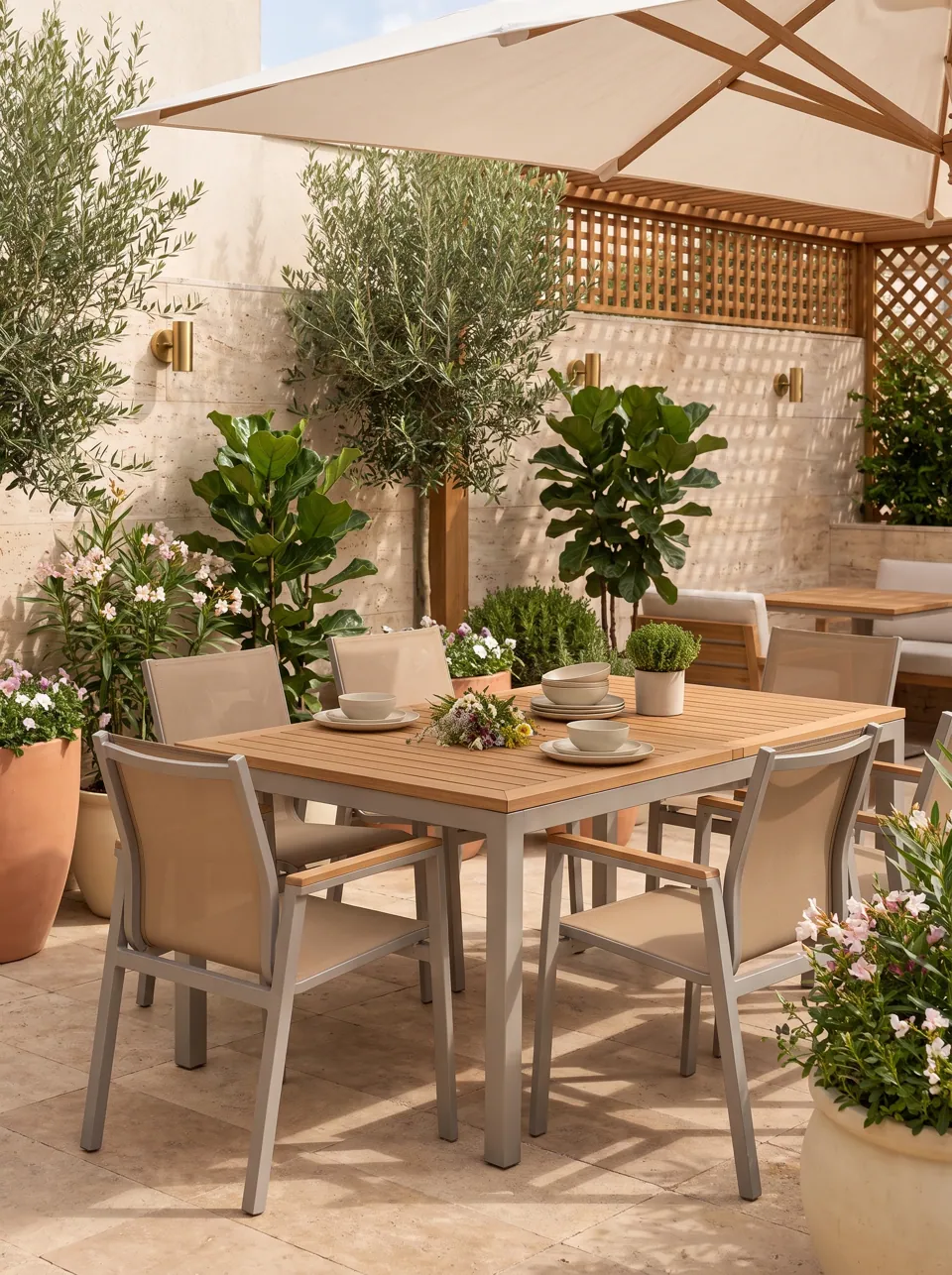
For most restaurant and hotel patios, powder-coated aluminum frames are the best default: they cannot rust, they are light enough to stack every night, and they take any color. Use fluoropolymer coatings and 316 stainless fasteners within sight of the sea, choose HDPE rather than PVC for synthetic wicker, and pick table tops (compact laminate, sintered stone or slatted aluminum) by how much heat, staining and wind they will see.
This guide compares the materials that actually show up in commercial outdoor furniture specifications, explains how each one fails, and gives a checklist for writing a spec that survives a full season. It is written by Alfresco Seat (a line by EASEN Commercial Furniture), and it applies whether you buy from us or not.
Why outdoor material choice matters more than style
Indoor furniture wears out from use. Outdoor furniture wears out from use plus four environmental loads:
- UV radiation breaks down polymers, fades pigments and chalks coatings.
- Water sits in joints, seat boxes and foam, feeding corrosion, mold and rot.
- Salt and chlorides from sea air, de-icing salt or pool chemicals attack metals and coatings.
- Thermal cycling from cold nights to hot afternoons opens cracks in coatings and brittle plastics.
A chair that costs a little less but needs replacing after two summers is the expensive option. Material choice is where that is decided.
Frame materials compared
| Frame material | Rust risk | Weight | Maintenance | Best for | Watch out for |
|---|---|---|---|---|---|
| Powder-coated aluminum | None (forms oxide, not rust) | Light | Rinse, touch up chips | Almost every patio | Light chairs can move in strong wind |
| Powder-coated steel | High where coating chips | Heavy | Inspect and repair chips | Sheltered, low-budget sites | Rust bleeding onto pavers |
| Galvanized + coated steel | Low to moderate | Heavy | Low | Windy sites needing weight | Weight for staff, cost of duplex coating |
| Stainless steel (304/316) | Low (316 lower near sea) | Heavy | Wipe, passivate if stained | Modern looks, coastal hardware | Tea staining on 304 near salt |
| Teak (Tectona grandis) | n/a | Medium-heavy | Oil or let weather silver-gray | Resort and heritage looks | Quality varies widely; cost |
| Acacia / eucalyptus | n/a | Medium | Regular oiling | Sheltered terraces | Checking, graying, shorter life outdoors |
| Molded resin (polypropylene) | None | Very light | Wash | Quick-service, overflow | Wind, UV chalking on cheap grades |
Aluminum: why it is the contract default
Aluminum does not rust. When its coating is damaged, the exposed metal forms a thin oxide film rather than red rust that spreads under the paint. Coating failure on aluminum still happens, usually as "filiform" corrosion creeping out from a chip, but it is slower and far less visible than steel rust. Two details decide how well an aluminum chair lasts:
- Pretreatment. Coating adhesion depends on the conversion coating applied before powder. Ask what pretreatment is used; a properly pretreated frame resists coating creep from chips much better.
- Coating class. Architectural coatings for aluminum are commonly described against AAMA 2603, 2604 and 2605, which set increasing exterior performance requirements, with 2605 the highest and typically met by PVDF or FEVE fluoropolymer systems. Standard outdoor polyester powders are fine for most patios; fluoropolymers are worth paying for on beachfronts, pool decks and high-UV rooftops. Ask the supplier for the coater's test data for your color rather than accepting a generic claim.
Our Coastline Marine-Grade Booth is the example of what changes for a coastal spec: fluoropolymer coating, sealed seams and 316 stainless fasteners.
Steel: heavy, cheap, and unforgiving
Steel's weight is an advantage on windy sites, and it is cheaper per piece. The problem is that every chip in the coating becomes a rust point, and rust expands under the paint. If you choose steel outdoors, insist on galvanizing under the powder coat (a "duplex" system) and accept that it will need inspection and repair.
Teak and other hardwoods
Plantation or reclaimed teak is naturally oily and dense, which is why it lasts outdoors without preservative. Left alone it weathers to silver-gray; that is surface graying, not rot. Keeping the honey color means regular cleaning and oiling. Acacia and eucalyptus look similar when new but are less durable outdoors and need more frequent oiling. Quality varies enormously with grade and drying, so ask for heartwood content and moisture content.
Seat and back materials compared
| Material | UV resistance | Dries | Comfort without cushion | Notes |
|---|---|---|---|---|
| Slatted aluminum | Excellent (coating-dependent) | Minutes | Fair to good | Hottest in direct sun if dark colored |
| Wood-look composite slats | Good | Fast | Good | No oiling; check for fade warranty terms |
| HDPE synthetic wicker | Good | Fast | Good | Better UV and cold performance than PVC |
| PVC synthetic wicker | Fair | Fast | Good | Can turn brittle and crack |
| Solution-dyed olefin or polyester rope | Good | Fast | Very good | Tension and full-frame wrapping matter |
| Textilene / PVC-coated mesh sling | Good | Fastest | Good | Very low maintenance |
| Upholstered (outdoor fabric + quick-dry foam) | Fabric-dependent | Varies | Best | Needs proper drainage and cushion care |
Two rules cover most of this table. First, color should be in the fiber. Solution-dyed cord, wicker and fabric have pigment added before extrusion; surface-dyed products fade where hands and sun hit them most. Second, water must have a way out. A woven seat over an open frame drains; a woven panel glued over a closed board does not.
Rope backs have a structural benefit too: wind passes through them. The Breezeway Rope-Back Bench uses an open rope back for exactly that reason on rooftops.
Table tops compared
| Top | Heat resistance | Stain resistance | Weight | Weather | Typical commercial use |
|---|---|---|---|---|---|
| Exterior compact laminate (HPL) | Good | Very good | Medium | Very good when exterior-grade | High-turnover dining |
| Sintered stone / porcelain | Excellent | Excellent | Heavy | Excellent | Upscale patios |
| Slatted aluminum | Good | Good | Light | Excellent, drains | Rooftops, casual dining |
| Wood-look composite slats | Moderate | Good | Medium | Good | Bistros, terraces |
| Solid teak | Moderate | Moderate | Medium | Good, weathers | Resorts |
| Natural stone (marble) | Good | Poor (acids etch) | Heavy | Fair | Avoid for busy outdoor dining |
Compact laminate is not the same as indoor laminate on particleboard. Exterior-grade compact panels are solid phenolic-core sheets with UV-stable surfaces; indoor-grade laminate on a board core will delaminate outside. Ask specifically for exterior-grade compact panel. Marble looks wonderful and etches the first time someone spills lemon or wine on it.
For most casual patios we recommend slatted or composite tops, as on the Pier Teak-Look Pedestal Table, because they drain and dry without staff wiping them after every shower.
Hardware and fasteners
The cheapest part of the chair often fails first. Zinc-plated screws rust within a season outdoors and stain everything below them. Specify:
- 304 stainless for most inland patios.
- 316 stainless within sight of the sea, at pools and wherever de-icing salt is used. Its molybdenum content gives it substantially better resistance to chloride pitting.
- Nylon or polymer isolators where stainless fasteners meet aluminum, to limit galvanic corrosion in wet, salty conditions.
- Replaceable glides with a drainage path, so water is not trapped under the leg.
How to write a materials spec: step by step
- Classify the site. Inland and sheltered, inland and exposed (rooftop), or coastal and pool. This decides coating class and fastener grade.
- Decide what is stored and what stays out. Stacking aluminum and resin suit nightly storage; booths and heavy tables stay out and need the best weather detailing.
- Choose frame material and coating system. Default to aluminum; specify the coating class and ask for coater data.
- Choose seat material by service style. Slats for fast turnover, rope or upholstered for long dinners.
- Choose fasteners. 304 inland, 316 coastal, isolated from aluminum.
- Choose table tops by menu and wind. Heavy tops for windy sites, non-porous tops for wine and citrus.
- Require drainage details on drawings. Drain holes, slat gaps, raised bases.
- Ask for a sample and a care sheet. See the actual weld, coating and weave before the full run.
Common mistakes
- Moving indoor furniture outside. Indoor booths with board seat boxes and standard foam turn into sponges. Use a booth designed for outdoors, such as our all-weather outdoor booths.
- Specifying steel to save money at a coastal site. The saving disappears with the first rust stain.
- Ignoring fasteners. A stainless-framed chair held together with plated screws is a plated-screw chair.
- Buying "teak" without grade information. Low-grade teak checks and grays unevenly.
- Choosing PVC wicker for full-sun sites. It can embrittle; ask for HDPE.
- Using marble or indoor laminate outside. Etching and delamination arrive within a season.
- Dark slatted metal in full sun with no shade. It can get very hot to sit on; choose lighter colors or shade.
FAQ
Is aluminum or teak better for restaurant patio furniture?
Aluminum is better for most restaurant patios because it is light, stackable, does not rust and needs very little maintenance. Teak is the better choice where a warm natural look is part of the brand and staff can accept either regular oiling or the silver-gray patina it develops when left alone.
Does powder-coated aluminum furniture rust?
Aluminum cannot produce red iron rust. Where the coating is chipped it oxidizes, and poor pretreatment can let corrosion creep under the coating as thin threads. Good pretreatment, a suitable coating class and prompt touch-up of chips keep this to a minimum.
What is the most durable outdoor table top for restaurants?
Sintered stone or porcelain and exterior-grade compact laminate are the most durable against heat, stains and weather. Sintered stone is heavier and more stable in wind; compact laminate is lighter and easier to handle. Avoid natural marble and indoor-grade laminate outdoors.
Is synthetic wicker suitable for commercial use?
Yes, if it is HDPE wicker woven around a powder-coated aluminum frame. HDPE generally performs better in UV and cold than PVC wicker, which can become brittle. Rinse the weave periodically to remove sand, salt and pollen.
Do I need 316 stainless steel hardware?
Within sight of the sea, around pools and where de-icing salts are used, yes. Elsewhere 304 stainless is usually sufficient. In either case isolate stainless fasteners from aluminum with nylon or polymer washers.
Send us your patio, rooftop or curb-lane plan with rough dimensions and seat count. We reply with layout suggestions, specification options and a quote.
Request a quote